
For routine visits, emergencies, and general enquiries
Get Direction

You had a tooth out a few days ago, and instead of settling down, the pain is getting worse.
Now you are wondering if something has gone wrong, and whether this is the dreaded dry socket everyone warned you about.
This guide walks you through the real signs of a dry socket, how to tell it apart from normal healing, how long it tends to last, and what actually helps.
Clear, calm, and based on trusted guidance, so you know what to do next.
A dry socket happens when the blood clot that should protect your extraction site is lost or never properly forms, leaving the bone underneath exposed.
The clearest sign is pain that gets worse around day 3, rather than easing, often with a bad taste or smell in your mouth.
If that sounds like you, it is worth calling your dentist. A dry socket is treatable, and getting it seen eases the pain much faster than waiting.
When a tooth is removed, a blood clot forms in the socket. That clot protects the bone and nerves underneath while the area heals.
A dry socket, known medically as alveolar osteitis, is when that clot is dislodged, dissolves, or does not form properly.
Without the clot, the bone and nerves are left exposed, which is why it can hurt so much more than normal healing.
It is one of the more common complications after a tooth extraction, though most people never get one.
Some soreness after an extraction is completely normal. A dry socket feels different.
The main signs to watch for are:
If you have several of these together, especially the worsening pain, it is a good reason to check in with your dentist.
A healing socket usually has a dark blood clot sitting in it.
With a dry socket, that clot is missing, so the socket can look empty or hollow, and you may see a pale, whitish, or greyish area of exposed bone.
That said, it is genuinely hard to see a socket at the back of your own mouth. Rather than relying on a mirror, let a dentist confirm what is going on.
This is the question most people are really asking.
Normal healing: the soreness is at its worst in the first day or two, then eases a little each day through the first week. The clot stays in place.
Dry socket: the pain eases at first, then gets noticeably worse around day 3 or 4. The socket looks empty, and there is often a bad taste or smell
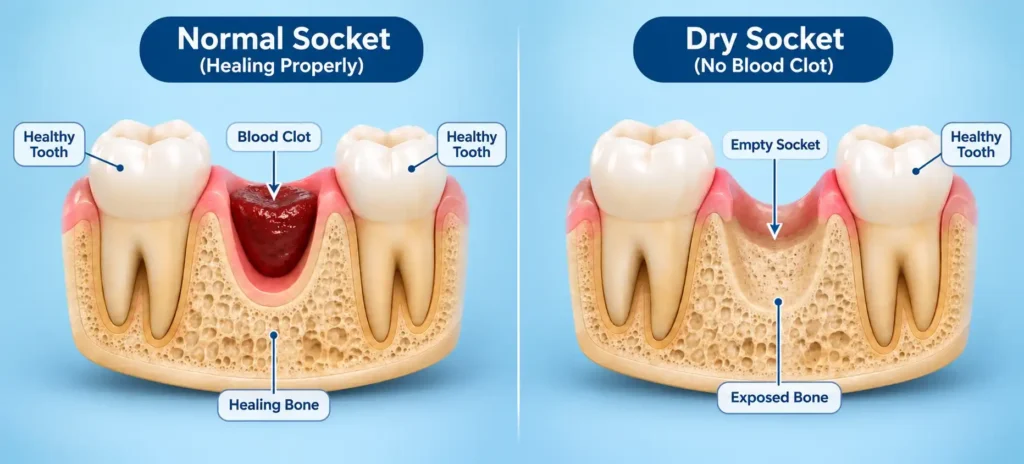
In short, improving pain points to normal healing. Pain that suddenly worsens after a few days points to a dry socket.
A dry socket usually makes itself known a few days after the extraction.
Left alone, the discomfort tends to settle within about 7 days, and sometimes up to around 10 days.
The good news is that you do not have to ride it out. Once your dentist treats it, the pain usually eases quickly.
In most cases a dry socket will heal in time, as the area slowly recovers on its own.
The reason most people still see their dentist is the pain. Treatment is mainly about relieving that pain and helping the socket settle, rather than forcing it to heal.
So while waiting it out is possible, it is usually the more uncomfortable path. You can read more in healthdirect’s guide to dry socket.
The most effective step is to see your dentist, who can gently clean the socket and place a medicated dressing to calm the pain.

While you arrange that, some general comfort measures can help:
Try not to poke or prod the area. If the pain is hard to manage, do not wait, since managing dental pain sooner is always easier than later.
You cannot control everything, but a few habits genuinely lower the risk.
These matter most in the first few days, and they are especially worth following after a wisdom teeth removal. For more on what to expect, see our guide to recovery after wisdom teeth.
It is worth booking in if:
These signs can also point to an infection such as a dental abscess, which a dentist should check. If the pain is severe or keeping you up at night, read our guide on when a toothache is urgent.
If your pain is getting worse instead of better, you do not have to wait it out.
A dentist can check the socket, ease the pain quickly, and rule out anything more serious like an infection.
When you are ready, book emergency dental care or simply get in touch with the Warner Dental team.
This article was prepared by the Warner Dental team and reviewed for general accuracy by Dr Pawan Bista, a registered dental practitioner (Dental Board of Australia registration number DEN0002295134). It reflects publicly available clinical guidance and is intended as general educational information rather than individual advice. You can read more about our dental team, including their qualifications and experience.
Disclaimer: This article is general educational information only, not dental advice, a diagnosis, or a treatment plan. It draws on public guidance from healthdirect Australia and the Australian Dental Association’s patient information, and no outcome is guaranteed. Only a registered dental practitioner can diagnose a dry socket and provide the right treatment after examining you. If you have severe or worsening pain after a tooth extraction, please see a dentist.
FAQs
Normal healing pain eases a little each day after the first day or two. A dry socket usually means pain that worsens around day 3, often with a bad taste or smell. If your pain is climbing rather than fading, check with your dentist.
The risk is highest in the first week after your extraction. Most people are generally in the clear by around 7 to 10 days, once the socket is healing well.
It follows the loss of the protective blood clot. Smoking, using straws, difficult or lower-jaw extractions, poor oral hygiene, and some medications can all raise the risk.
Yes. Stitches help hold things together, but a dry socket can still happen, so it is worth following your aftercare just as closely.
A dry socket is defined by its pain, so a socket that looks empty but does not hurt is more likely to be normal healing. If you are unsure, your dentist can tell you.
Yes. A bad taste or an unpleasant smell is a common sign, usually alongside the worsening pain.
They will usually clean the socket gently and place a medicated dressing to settle the pain. They may ask to review it over the following days to check it is healing.
It is not usually dangerous, but it is painful and worth treating promptly, partly to ease the pain and partly to rule out an infection.
Most dry sockets appear within the first few days, but later cases can happen. It is sensible to stay alert to the signs through the whole first week.
Many people feel noticeably better within a day or two of treatment, with the socket healing over roughly a week.
Related Blogs