
For routine visits, emergencies, and general enquiries
Get Direction
Oral Hygiene Instructions

Good oral health starts with what you do at home every day. At Warner Dental, providing practical oral hygiene advice to patients in Warner and north Brisbane has been part of the practice since it opened in 2002. Whether you want to know how to brush your teeth correctly, improve your flossing routine, or help your child develop good habits, the team takes time at every appointment to give you guidance that is specific to your teeth, your gums, and your lifestyle.
Oral hygiene instructions are the personalised guidance a dental team provides to help you care for your teeth and gums at home. This is not a one-size-fits-all checklist. The advice you receive is based on your current oral health, your history of decay or gum problems, and the specific areas where plaque is building up.
Home care covers brushing technique, interdental cleaning such as flossing or the use of interdental brushes, diet habits that affect enamel and caries risk, and the correct use of fluoride products. Most people learned their brushing habits in childhood and have never had those habits properly assessed by a dental professional.
Receiving clear guidance from a dentist means small problems in technique or routine can be identified and corrected before they lead to decay, gingival inflammation, or more serious periodontal concerns.
Oral hygiene guidance is relevant for every patient, but it is especially worth discussing with your dentist if you notice any of the following:
These situations all affect how you should approach your home care routine. A general adult brushing technique is not always appropriate for every situation, and your dentist can help you adapt.
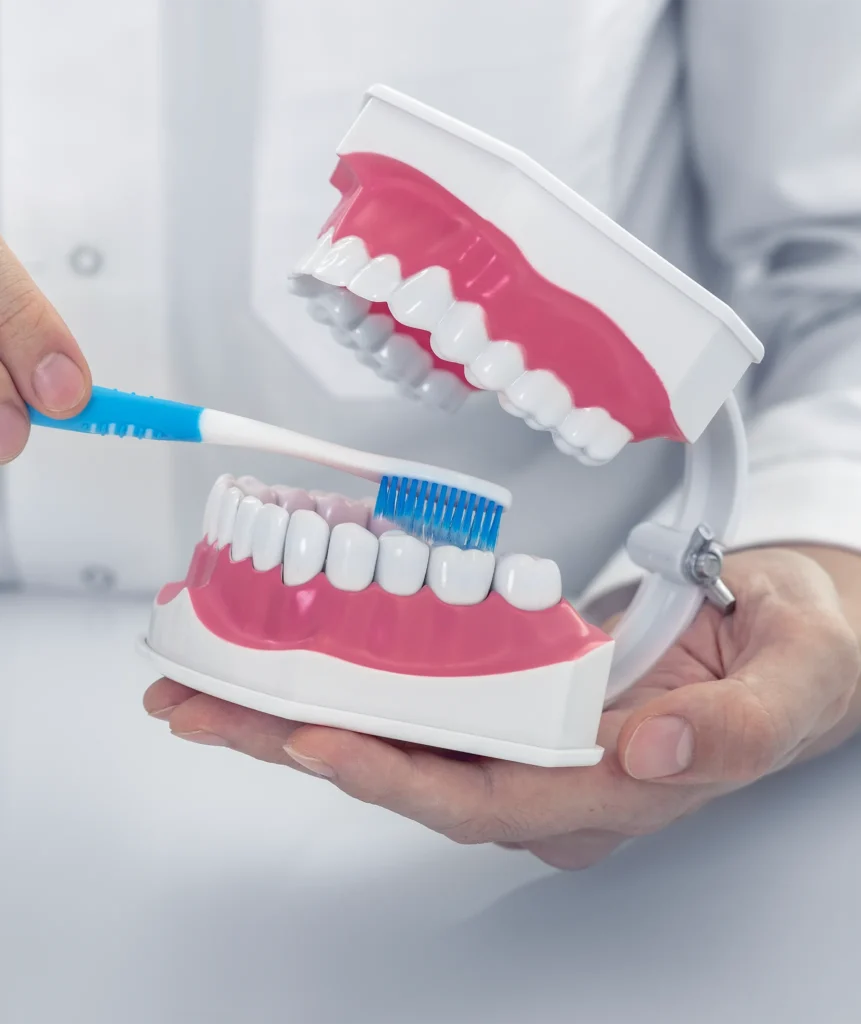
At the start of a hygiene consultation, the dentist or oral health therapist will review your current brushing and flossing habits. They will look at the areas of your mouth where plaque and calculus are accumulating most and ask about your diet and any products you are currently using. This gives a realistic picture of where your routine is working and where it is not.
The team will show you the correct brushing technique for your situation. For most patients this involves holding the toothbrush at a 45-degree angle to the gumline, using gentle circular strokes, and spending enough time on each area to remove plaque effectively. You will also receive guidance on interdental cleaning, including whether string floss, floss picks, interdental brushes, or a water flosser is most suitable for your tooth spacing and any restorations you have.
Most adults benefit from a fluoride toothpaste with at least 1,000 ppm fluoride. Children under six should use a low-fluoride formulation designed for their age. Patients with a higher decay risk may be advised to use a prescription-strength fluoride product. The team will recommend what is appropriate for your specific situation.
Oral hygiene advice is not a one-off conversation. At each appointment, the dentist will check whether your technique has improved and whether new concerns have developed. This ongoing relationship between patient and practitioner is what makes advice from a dental team more effective than general information found online.
What you eat and drink affects your teeth just as much as how you brush. Frequent consumption of sugary or acidic foods and drinks lowers the pH in your mouth, which softens enamel and raises caries risk over time. Limiting these foods, particularly between meals, gives your saliva time to remineralise the enamel surface between eating occasions.
Fluoride plays a direct role in strengthening enamel and reducing the rate at which decay progresses. Drinking fluoridated tap water, using a fluoride toothpaste, and attending routine dental check-ups and cleans at Warner Dental are among the most effective steps you can take to help protect your teeth from decay.
The Australian Government Department of Health provides publicly available information on preventive dental care, fluoride safety, and national oral health guidelines for Australians of all ages.
Warner Dental has been part of the Warner community since 2002. Over more than two decades, the practice has built long-term relationships with patients across Warner, Bray Park, Lawnton, Cashmere, Joyner, and surrounding north Brisbane suburbs. That continuity matters when it comes to preventive care, because the team can track changes in your oral health over time and adjust their advice accordingly.
Oral hygiene advice at Warner Dental is based on what the dentist actually finds in your mouth at that visit, not a standard handout given to every patient. If plaque is consistently building up in the same areas, the team identifies why and adjusts the technique guidance accordingly. This means advice improves over time as the team builds a clearer picture of your individual brushing habits, gum response, and decay risk.
Warner Dental also works with patients across a wide age range. The team’s experience in children’s dentistry at Warner Dental means parents can receive practical guidance for their children at the same appointment, making it easier to build consistent habits for the whole family. The practice is accessible for new and existing patients and welcomes patients from across north Brisbane.
Warner Dental welcomes new and existing patients from Warner, Bray Park, Strathpine, Lawnton, and across north Brisbane. If you would like to have your oral hygiene routine reviewed or simply want practical advice on how to care for your teeth at home, the team is ready to help at a time that suits you.
Protect your smile with regular care at Warner Dental.
For most adults in good oral health, a professional scale and clean every six months is appropriate. Some patients with a history of gum disease, higher decay rates, or significant calculus build-up may benefit from more frequent visits. Your dentist will advise on the right schedule for your circumstances after reviewing your oral health. Attending regularly also gives the team the opportunity to update your home care advice as your needs change.
Bleeding when you floss is usually a sign of early gingival inflammation, not a reason to stop. With consistent and correct flossing over one to two weeks, bleeding often reduces as the gum tissue becomes healthier. If bleeding persists beyond that timeframe or is accompanied by swollen or receding gums, it is worth booking an appointment. You can find more detail on our gum health and bleeding gums page.
Both types can be effective when used correctly. Electric toothbrushes can be particularly helpful for patients who apply too much pressure with a manual brush, which can wear away enamel over time. They can also be useful for patients with limited dexterity. If you are unsure which is right for you, the team can give you a recommendation at your next appointment based on your brushing habits and oral health.
Healthy gums that are firm and pink without bleeding, no persistent bad breath, and a clean smooth feeling after brushing are all positive signs. If you are unsure, disclosing tablets available from most pharmacies will stain areas of plaque you have missed, giving you a clear picture of where your technique needs improvement. The team can also assess your technique in-chair and show you exactly where plaque is accumulating.
For most adults, a fluoride toothpaste containing at least 1,000 ppm fluoride is appropriate for daily use. If you have sensitivity, dry mouth, or a high decay risk, there are specific formulations that may be more suitable. The ADA guide to brushing teeth provides practical guidance on selecting oral health products and brushing technique. The team at Warner Dental can recommend a product suited to your specific oral health needs at your next visit.
Fissure sealants are a thin protective coating applied to the chewing surfaces of back teeth, where decay most commonly begins in children. They work alongside good brushing habits rather than replacing them. You can read more on the fissure sealants for children page. The team can assess at a check-up whether sealants are appropriate for your child based on their age and the development of their permanent teeth.
Persistent bad breath is most often caused by bacteria on the tongue, between the teeth, or below the gumline. Brushing your tongue as part of your daily routine, flossing consistently, and staying well hydrated can all help. If bad breath continues despite good home care, it is worth raising with your dentist, as it can sometimes indicate an underlying dental or gum issue that needs professional attention.
Thorough examination, professional clean, and fluoride application to maintain healthy teeth and gums.
Protective coatings applied to back teeth to reduce the risk of decay.
Custom-fitted appliances for sports protection and management of teeth grinding (bruxism).
Compassionate, patient-focused care for those who feel nervous about dental treatment.
Clear, detailed assessments to help you make informed decisions about your dental health.
Assessment and treatment of enamel wear caused by grinding, acid erosion, or ageing.
Saving infected or damaged teeth by removing infection and restoring strength.
Natural-looking restorations to repair cavities and protect tooth structure.
Custom-made restorations to strengthen and protect weakened teeth.
Replacing missing teeth to restore function and maintain alignment.
Removable options to replace multiple or all missing teeth and improve chewing ability.